


STRATA™ – A Modern, Defensible Approach to Tree Risk Assessment
STRATA™ (Structured Tree Risk Assessment and Tracking Analysis) is Mapscape’s evidence-based framework for assessing and managing tree risk.
It provides a consistent, transparent, and defensible method of tree risk assessment, grounded in the National Tree Safety Group (NTSG), BS 3998, and HSE INDG 317 guidance, with optional alignment to ISO 31000 risk management principles.
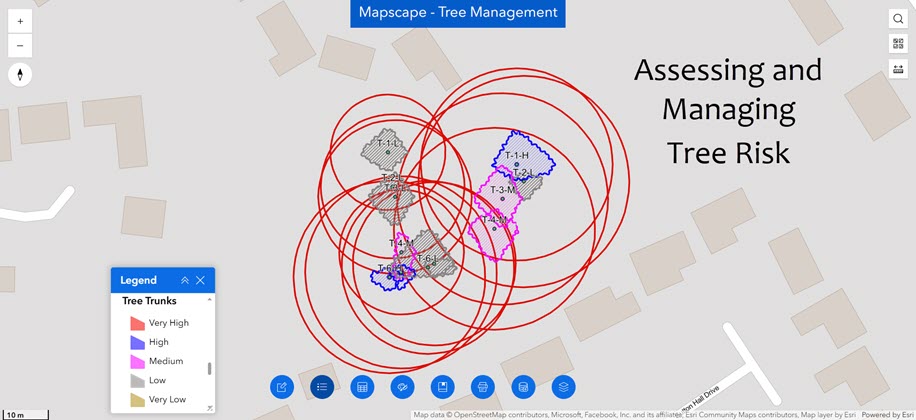
Developed for arborists, estates, housing providers, and public bodies, STRATA™ links:
- On-site tree condition data
- Target-zone assessment
- Likelihood and consequence ratings
- Automated work-priority outcomes
- Fully auditable digital records
- Visual mapping for estates of any size
STRATA™ is for arboricultural consultants, estate-wide surveys, planning applications, and TPO-related assessment work, providing duty-holders with decisions that stand up to internal review, public scrutiny, and legal challenge.
Why use STRATA™
STRATA™ provides a practical and defensible risk-assessment workflow for:
SMEs & Arboricultural Contractors
- A structured, professional method suitable for Tree Preservation Order (TPO) applications
- Clear, consistent risk ratings that support quotes, consultancy, and client reporting
- Carbon-linked evaluations that add value for sustainability-driven clients
Housing Associations, Councils & Estate Managers
- Site-wide consistency across contractors and surveyors
- Digital mapping of every tree, condition, and risk rating
- Built-in reinspection cycles and audit trails
Practical and defensible risk-assessment
Sustainability, ESG & Carbon Reduction Teams
- Integrates seamlessly with Mapscape’s carbon-calculation tools
- Tree retention, replacement and canopy-growth projections support green-asset planning
- Enables scenario planning (e.g., risk vs carbon value)
Planning and Legal Defensibility
- Designed to align with NTSG guidance and HSE expectations
- Optional ISO 31000 alignment for organisations that need formal governance
- Fully documented decision logic, photographs, defect notes, and overrides
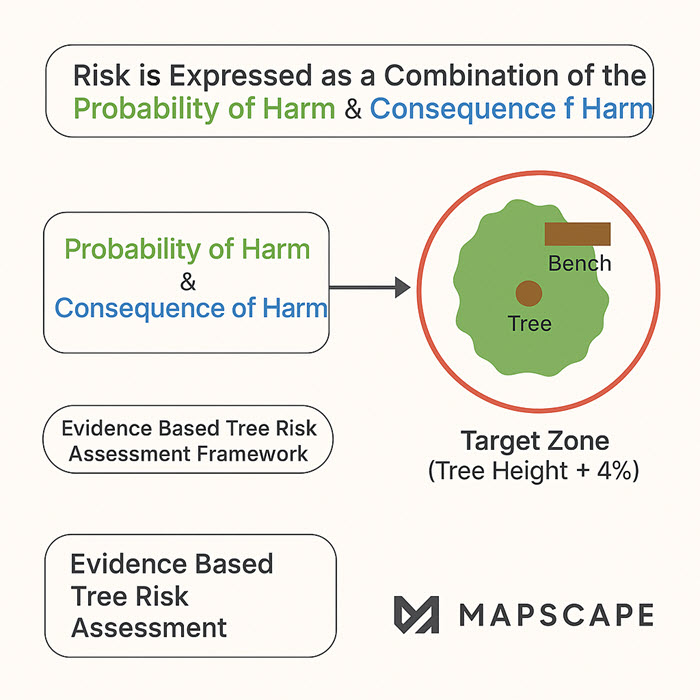
The STRATA™ Method – Step by Step
STRATA™ follows a four-stage structure, ensuring every decision is consistent and reproducible.
1. Assessment - Evidence Collection in the Field
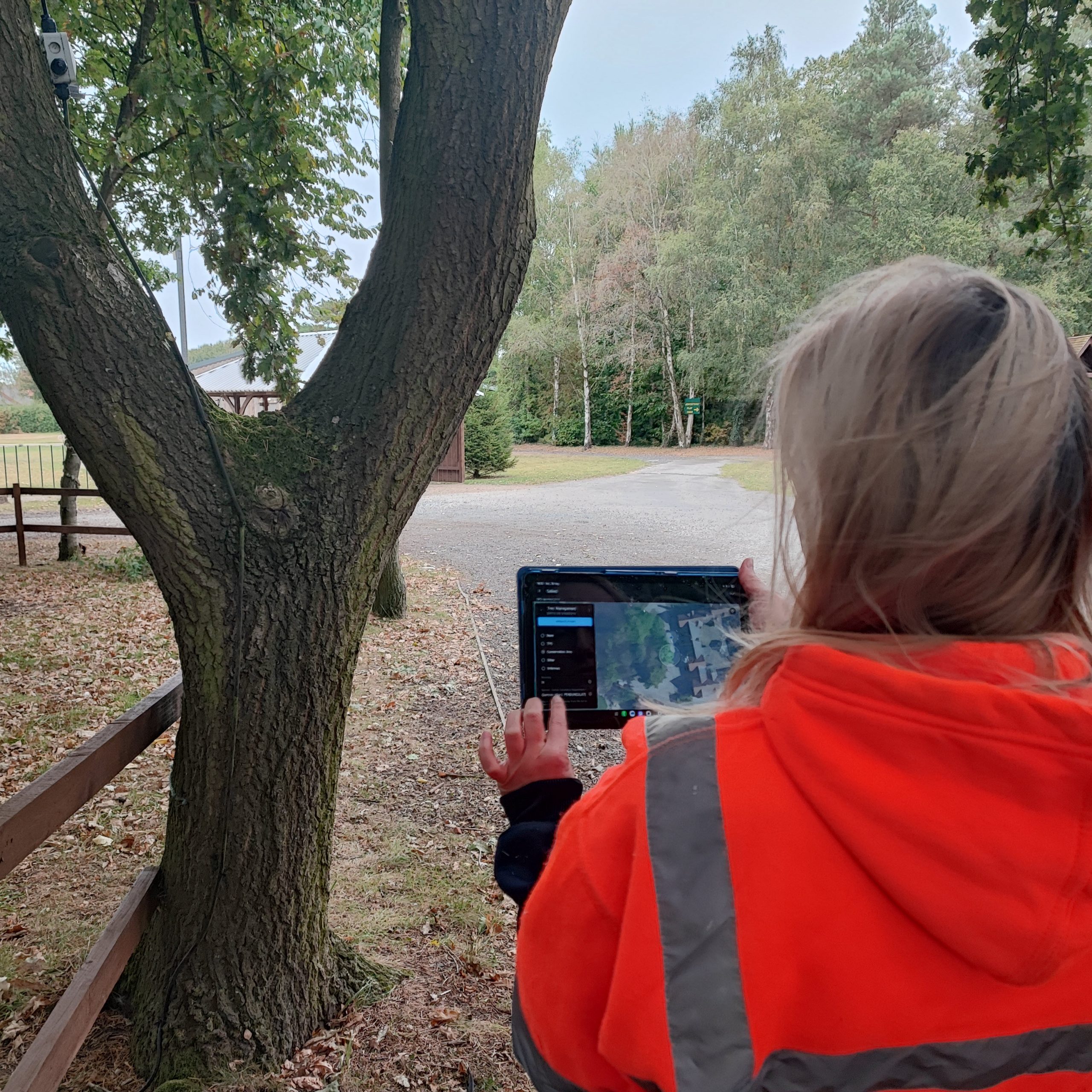
Arboricultural surveyors record all relevant condition data using Mapscape’s mobile tools:
DBH, height, canopy spread and target-zone details
Root, trunk, crown and leaf assessments
Defects, fungal fruiting bodies, cavities and structural concerns
Environmental and site factors (traffic, footfall, buildings, utilities)
Photographs, supporting notes, GPS-verified tree locations
2. Consideration - Understanding the Target Zone
The system requires surveyors to define:
Human activity levels
Vehicle movement
Environmental constraints
Tree characteristics and defects
Providing a structured target-zone description ensures that the likelihood of harm reflects real-world usage, not just the tree’s defects.
3. Selection - Likelihood × Consequence scoring (1–5 × 1–5)
Arboricultural surveyors select from clear, illustrated definitions for each level, ensuring consistency regardless of who assesses the tree.
To be Completed
These scales reflect sector expectations and can be aligned with organisational risk criteria for ISO 31000 compliance.
4. Outcome - Automated Work Priority
Based on the Arboricultural Surveyors tree risk assessment, Mapscape automatically calculates a work priority:
Very High – immediate action
High – urgent works required
Medium – scheduled works
Low – minor maintenance
Very Low – monitoring only
Overrides are permitted where necessary, with mandatory justification captured to maintain auditability.
Mapscape delivers a clearer, defensible measure of tree-related risk by combining the likelihood and severity of harm directly within the defined target zone.
Tracking & Review – A Modern Risk-Management Cycle
STRATA™ integrates monitoring and management into a continual improvement loop:
- Reinspection cycles automatically scheduled
- Tree-condition change tracked over time
- Mapping layers show past surveys, works, and upcoming priorities
- Completed works update the risk status
- Trend and cluster analysis support smarter budgeting
This turns surveys from “snapshots” into a living, evolving management system aligned with ISO 31000 principles: monitoring, review, evaluation and improvement.
STRATA™ and ISO 31000 Alignment
Purpose: Strengthen credibility and match public-sector expectations.
Aligned with ISO 31000 Risk-Management Principles
While ISO 31000 is not certifiable, STRATA™ supports alignment through:
- Consistent, structured assessment
- Documented criteria and rationale
- Integrated monitoring and review cycles
- Transparent, traceable decision-making
- Embedding risk management into organisational decision processes
Designed Around UK Best Practice
STRATA™ complements:
- NTSG – Common Sense Risk Management of Trees
- BS 3998 (Tree Work: Recommendations)
- BS 5837 (Trees in Relation to Design, Demolition and Construction)
- HSE INDG 317
- Local Authority TPO application requirements
- Professional Indemnity and audit obligations
Added Value: Carbon & ESG
Tree Risk, Carbon Value, and Sustainability – All in One System
Unlike traditional tree-risk methods, STRATA™ connects directly with Mapscape’s sustainability tools:
- Automatic carbon storage and sequestration calculations into 2050+
- Woodland Management tools
- Compatible with tree-planting, project cost and establishment app
- Decision support for risk vs carbon value
This makes STRATA™ ideal for organisations balancing safety, cost, biodiversity and carbon reduction commitments.
From Recommendation to Completed Works, Fully Tracked
Attach photos of observable defects direct from your mobile device , images are compressed and linked to each tree in both the map and the automated spreadsheet report.
- Record who assessed each tree, what they recommended, and by when work should be completed.
- Use the Sign-Off Works option as a simple green/red traffic light system to track progress – ideal for sharing with subcontractors and in-house teams.
- Log re-inspections to show that risk is being actively managed, not just assessed once and forgotten.
This gives duty-holders a clear line of sight from initial survey to completed works, making it easier to demonstrate reasonable care.
A Framework Under Continuous Development
The Mapscape Tree Risk Assessment Framework is being developed as a robust, health-and-safety-audited, science-based methodology that helps arboricultural professionals and duty-holders make informed, defensible decisions.
The core framework – including risk scoring, mapping, reporting and sign-off – is already in commercial use.
An advanced method, shown above, is in development and we are actively seeking feedback from risk management specialists, insurers and health & safety evaluators.
Start Using STRATA™ Today
See how Mapscape can transform your tree-risk process with consistent, defensible assessment linked to carbon and sustainability planning.
Book a quick Demo to see how the framework will work for your business and organisation, or contact us directly if you have any questions.
Reference Document:
*National Tree Safety Group. Common sense risk management of trees. 2nd Edition. PDF